LHCb releases service to access Run II data
2026-02-22 by LHCb Collaboration
The LHCb collaboration is happy to announce the official release of the LHCb Ntupling Service: a web service for on-demand production and publishing of custom LHCb open data. This provides the public access to both Run I, and for the first time, Run II pp data collected by LHCb. This amounts to over 4 PB of data to explore! The image displays an event recorded during Run II.
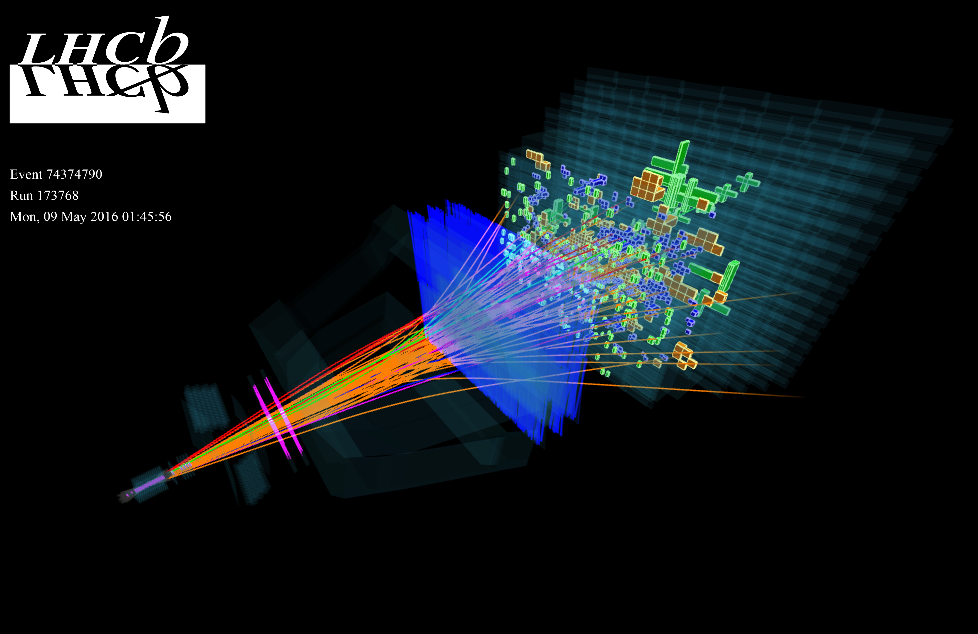
A typical LHCb event fully reconstructed during data taking on May 9th 2016.
Particles identified as pions, kaon, etc. are shown in different colours.
This follows the release of the full Run I pp data on the CERN Open Data Portal in December 2023. While for the previous release, knowledge of the LHCb software stack was necessary for subsequent analysis of the released data, this is no longer the case for users of the LHCb Ntupling Service. Instead, custom ntuples are produced containing a collection of physics objects and quantities based on user specifications. The Ntupling Service serves as an all in one place for users to request custom ntuples with LHCb data, track the request process, communicate with the LHCb open data team, and download the resulting ntuples.
During the ntuple creation step, users interact with the LHCb Ntuple Wizard, providing an intuitive step-by-step process for specifying their ntuple configuration. This process consists of (1) selecting a physics object of interest, (2) choosing a corresponding dataset, and (3) specifying the configuration of the corresponding ntuples.
This release marks a significant advancement in the LHCb open data infrastructure, and is an exciting step for the larger open data community, where the barrier for entry of data analysis is lowered without the need for any experiment specific software. The release is accompanied by a growing usage guide with a detailed walkthrough for request submission and tracking, in addition to analysis example workflows with the resulting ntuples.
This work was carried out through the Data Processing & Analysis project of LHCb in collaboration with CERN’s Information Technology Department. The LHCb collaboration would like to thank the CERN Information Technology Department for co-designing, co-developing and co-operating the new service.








Open Data Portal v1.3.0
